
In today’s rapidly expanding power infrastructure, selecting the right overhead conductor is critical for performance, reliability, and long-term cost control. Among the most widely used solutions, AAC cable continues to play a vital role in urban and industrial distribution networks around the world.
This guide provides engineers and procurement professionals with a practical, technical, and purchasing-focused overview of AAC cable its construction, advantages, applications, and how to source it confidently from a qualified manufacturer such as HNBF Power.
What Is AAC Cable?
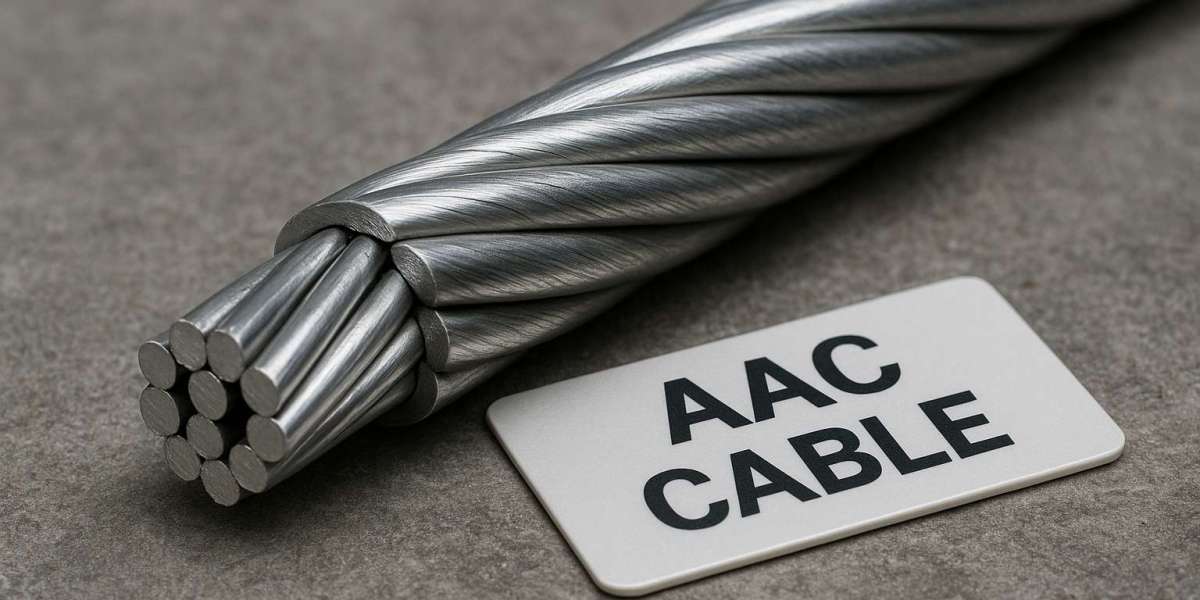
AAC cable stands for All Aluminium Conductor. It is an overhead bare conductor composed entirely of one or more strands of hard-drawn aluminium wires. Unlike reinforced conductors, AAC contains no steel or composite core, making it a lightweight and highly conductive solution for power distribution.
The simplicity of AAC cable design delivers excellent electrical performance while maintaining ease of handling during installation.
Key Construction Features of AAC Cable
1. 100% Aluminium Stranding
AAC cable is manufactured using stranded aluminium wires arranged concentrically. This design improves mechanical flexibility and simplifies jointing and termination.
2. High Electrical Conductivity
Because the conductor is made entirely of aluminium, AAC cable provides a higher conductivity per unit weight compared with reinforced conductors.
3. Corrosion Resistance
Aluminium naturally forms a protective oxide layer, which makes AAC cable highly suitable for coastal, industrial, and high-humidity environments.
Why AAC Cable Is Still Widely Used in Power Networks
Excellent Conductivity-to-Weight Ratio
AAC cable offers one of the best conductivity-to-weight ratios among overhead conductors. This allows utilities and contractors to achieve efficient power transmission without increasing structural loads on poles and towers.
Lower Installation Cost
The lightweight structure reduces transportation, handling, and installation effort. For urban distribution lines, this translates directly into lower project costs and shorter installation schedules.
Strong Performance in Short and Medium Spans
Although AAC cable has lower tensile strength than reinforced conductors, it performs extremely well in short to medium span networks, especially where mechanical loading is not critical.
Typical Applications of AAC Cable
AAC cable is primarily used in:
Urban and suburban overhead distribution systems
Industrial plant power networks
Coastal and high-corrosion areas
Low and medium voltage distribution lines
Short-span transmission and feeder lines
For projects where mechanical strength is less demanding but electrical efficiency and corrosion resistance are priorities, AAC cable remains a highly competitive option.
AAC Cable vs. ACSR and AAAC - How to Choose Correctly
AAC Cable vs. ACSR
ACSR (Aluminium Conductor Steel Reinforced) includes a steel core to increase tensile strength. While ACSR is suitable for long spans and high mechanical loads, it is heavier and more complex to install.
AAC cable, by contrast, is ideal when:
Span lengths are short
Mechanical loads are moderate
Maximum conductivity is required
Corrosion resistance is critical
AAC Cable vs. AAAC
AAAC (All Aluminium Alloy Conductor) uses aluminium alloy instead of pure aluminium. AAAC offers higher tensile strength but slightly lower conductivity.
AAC cable is typically preferred when:
Electrical performance is the primary requirement
Network layouts are compact
Installation speed and flexibility are important
Technical Advantages Engineers Value in AAC Cable
High Current-Carrying Capacity
Due to its superior conductivity, AAC cable supports high current levels for its cross-sectional area. This makes it well suited for densely populated distribution networks.
Simple Jointing and Accessories
The homogeneous aluminium construction allows the use of standard aluminium fittings and connectors, reducing accessory complexity and minimizing installation errors.
Lower Line Losses
For short-distance distribution, AAC cable can deliver lower electrical losses compared to reinforced conductors of similar weight.
How HNBF Power Supports AAC Cable Projects
As a professional global manufacturer of overhead conductors and power cables, HNBF Power supplies a full range of:
AAC cable
AAAC
ACSR
ABC (Aerial Bundled Cable)
LV power cable
Concentric cable
HNBF Power integrates modern stranding lines, advanced quality inspection systems, and strict process control to ensure stable conductor diameter, accurate lay length, and consistent electrical performance.
For engineering teams and procurement managers, this means:
Reliable dimensional consistency
Verified electrical and mechanical parameters
Flexible production for customized sizes and standards
Stable delivery schedules for large infrastructure projects
Whether the project is a municipal distribution upgrade or an industrial power expansion, HNBF Power can support both standard and tailor-made AAC cable specifications.
How to Select the Right AAC Cable for Your Project
1. Define Electrical Requirements
Confirm operating voltage, current demand, and expected future load growth.
2. Check Span Length and Mechanical Conditions
AAC cable is best for shorter spans and moderate mechanical loads. Environmental conditions such as wind and ice loading should also be evaluated.
3. Confirm Standard and Compliance
Ensure the conductor meets the applicable national or international standards required by your utility or project owner.
4. Work with an Experienced Manufacturer
Choosing a manufacturer with proven production capacity and export experience significantly reduces project risks related to quality, documentation, and delivery.
Frequently Asked Questions About AAC Cable
What is the main advantage of AAC cable compared to other overhead conductors?
The main advantage of AAC cable is its high electrical conductivity combined with lightweight construction, making it ideal for short-span distribution networks with lower mechanical stress.
Is AAC cable suitable for coastal environments?
Yes. AAC cable offers excellent corrosion resistance and is commonly used in coastal and high-humidity regions where steel-reinforced conductors may experience faster degradation.
Can AAC cable be used for medium-voltage networks?
AAC cable is widely applied in low and medium voltage overhead distribution systems, especially in urban and industrial environments.
How long is the typical service life of AAC cable?
When properly designed and installed, AAC cable can operate reliably for several decades, depending on environmental exposure and maintenance practices.
Partner with HNBF Power for Your AAC Cable Requirements
If you are planning an overhead distribution project and require reliable, cost-effective, and technically proven AAC cable, HNBF Power is ready to support your engineering and procurement teams.
Contact HNBF Power today to discuss your project requirements and receive customized AAC cable solutions tailored to your network design, standards, and delivery schedule.